The EU Anti-Money Laundering Authority (AMLA) is the first EU body dedicated to supervising how member states and financial institutions apply anti-money laundering rules. It was created as part of the 2024 EU AML package and is a key piece of the new “Single Rulebook” architecture. This guide explains what AMLA is, what powers it has, where it sits, and what it means in practice.
What is AMLA?
AMLA (Anti-Money Laundering Authority) is an EU agency that combines two roles. First, it coordinates and supports national supervisors so that the same AML rules are applied consistently across the single market. Second, from 2028 it will directly supervise up to 40 high-risk financial groups operating in at least six Member States. It is based in Frankfurt am Main and has been operational since 1 July 2025.
The logic is simple. Money laundering crosses borders, but supervision has always been national. AMLA closes that gap by acting as the central supervisor with the widest view of the EU market.
Legal basis: Regulation (EU) 2024/1620
AMLA was established by Regulation (EU) 2024/1620 of 31 May 2024, published in the Official Journal on 19 June 2024 as part of the 2024 AML package. The regulation defines AMLA’s tasks, governance, and its relationship with national authorities. It works alongside the AML Regulation (AMLR, 2024/1624) and the new AML Directive (AMLD6, 2024/1640).

What AMLA does
Indirect supervision and coordination
AMLA will review how national supervisors do their job, run peer reviews, and push for consistent, high-quality supervision across the EU. It will also collect and analyse data on AML risks, issue guidelines, draft the regulatory and implementing technical standards (RTS/ITS) that flesh out the AMLR, and host and develop FIU.net, the secure network used by national financial intelligence units.
Direct supervision from 2028
The more visible role starts in 2028, when AMLA begins direct supervision of selected high-risk obliged entities. This covers up to 40 credit and financial groups operating in at least six Member States, selected according to a harmonised risk methodology. Once selected, they report to AMLA rather than only to their national supervisor, and AMLA may impose pecuniary sanctions, up to EUR 10 million for serious, repeated or systematic breaches.
AMLA and national authorities
AMLA does not replace national supervisors; it sits above and beside them. In Poland, for example, it will work with the general inspector of financial information and with existing national supervisors. The same pattern applies in every member state: AMLA sets the common standard, national bodies enforce it day to day, and AMLA steps in directly for the largest cross-border players.
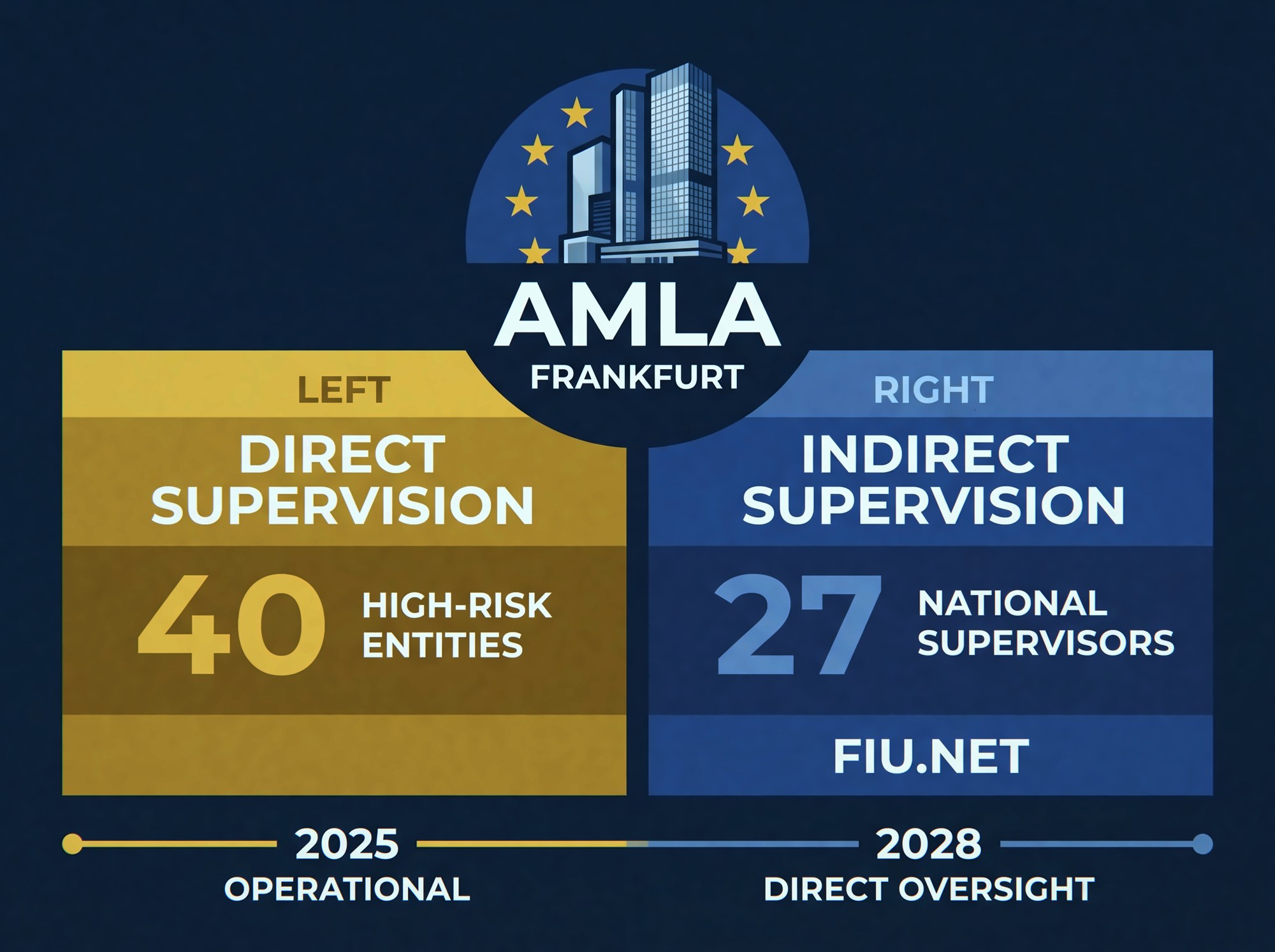
Timeline 2025 to 2028
| Date | Milestone |
|---|---|
| 19 June 2024 | Regulation (EU) 2024/1620 published |
| 1 July 2025 | AMLA becomes operational in Frankfurt |
| 2025 to 2026 | Recruitment, governance setup, first guidelines and draft RTS/ITS |
| 2027 | Selection process for directly supervised entities |
| 2028 | AMLA starts direct supervision |
What AMLA means for UK firms
The UK is outside the EU and not part of AMLA’s remit. British firms continue to be supervised by the FCA under the Money Laundering Regulations 2017. However, UK groups with EU subsidiaries, branches, or client relationships should expect AMLA to shape the standard their EU operations are measured against, because it will drive consistent supervision across the single market. Building AMLA-aligned AML governance now makes cross-border compliance easier later.
Frequently asked questions
What does AMLA stand for?
AMLA is the Anti-Money Laundering Authority of the European Union, established by Regulation (EU) 2024/1620 and based in Frankfurt. It coordinates national AML supervisors and, from 2028, directly supervises up to 40 high-risk groups operating in at least six Member States.
Where is AMLA based?
AMLA is headquartered in Frankfurt am Main, Germany. It became operational on 1 July 2025 and will grow its staff and powers over the following years.
When does AMLA start supervising?
AMLA takes on indirect coordination functions first, after becoming operational in 2025. Direct supervision of a selected group of high-risk obliged entities begins in 2028, following a selection process.
Does AMLA apply to UK firms?
Not directly. UK firms remain under the FCA and the Money Laundering Regulations 2017. But UK groups with EU operations should align with the standard AMLA drives, since it will shape supervision across the EU.