The EU AML package 2024 is the biggest overhaul of European anti-money laundering rules in a decade. It replaces a patchwork of national transpositions with a single, directly applicable rulebook, creates a new EU supervisory authority, and adds a brand new anti-money laundering directive. For compliance teams the practical question is simple: what changes, when does it apply, and how do we get ready?
This guide explains the three legal acts behind the package, the key dates, and the concrete changes for politically exposed person (PEP) screening and customer due diligence, including what it means for UK firms that serve EU clients.

What is the EU AML package 2024?
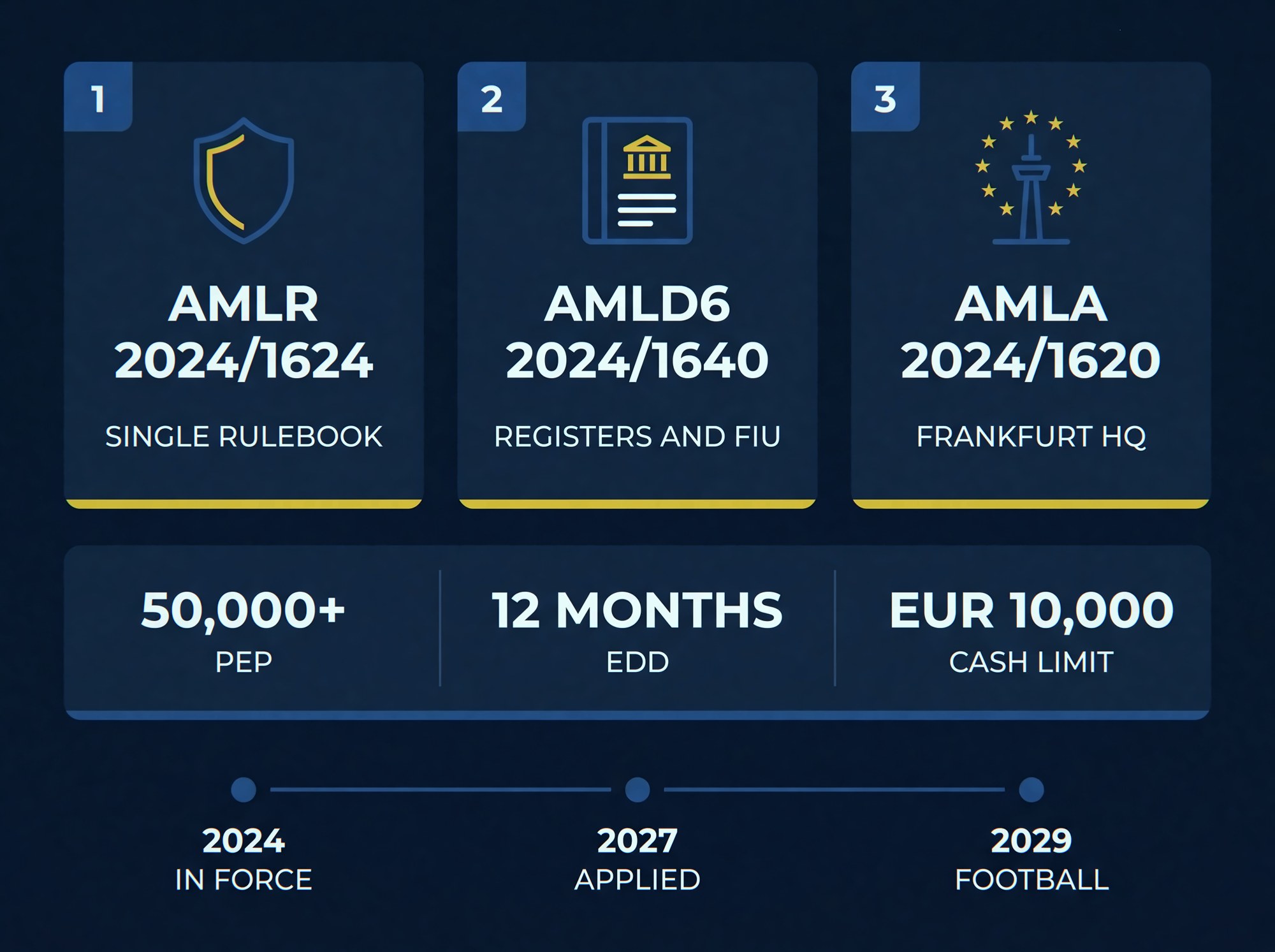
The 2024 AML package (also called the “Single Rulebook”) was published in the Official Journal on 19 June 2024 and entered into force on 9 July 2024. It consists of three acts that work together:
- Regulation (EU) 2024/1624, the AML Regulation (AMLR), which contains the detailed due diligence obligations for obliged entities and applies mainly from 10 July 2027.
- Directive (EU) 2024/1640, the new (sixth) AML Directive, which covers institutional and supervisory rules, with national transposition by 10 July 2027.
- Regulation (EU) 2024/1620, which establishes the new EU AML Authority (AMLA), based in Frankfurt and operational since 1 July 2025.
The three pillars of the 2024 package
Regulation (EU) 2024/1624, the AML Regulation (AMLR)
The AMLR is the core of the reform. Because it is a regulation, it applies directly in every member state without national transposition, which ends the current problem of 27 slightly different rulebooks. It sets out the detailed customer due diligence rules: identification and verification, beneficial ownership, enhanced due diligence (EDD), and the treatment of politically exposed persons. It also introduces an EU-wide cash limit of EUR 10,000 for certain payments and extends the rules to most of the crypto-asset sector.
Directive (EU) 2024/1640, the new AMLD6
The name “AMLD6” is now used for two different acts, which causes real confusion. The original sixth AML Directive, Directive (EU) 2018/1673, is a criminal-law instrument: it harmonises the definition of money laundering and the penalties across the EU but does not regulate customer due diligence. The new Directive (EU) 2024/1640 is an institutional text: it sets the rules for national supervisors, financial intelligence units (FIUs), central bank account registers, and beneficial ownership registers, and it must be transposed into national law by 10 July 2027.
Regulation (EU) 2024/1620, the EU AML Authority (AMLA)
AMLA is the new EU body that coordinates national supervisors and, from 2028, will directly supervise up to 40 high-risk financial groups operating in at least six Member States. It is based in Frankfurt and has been operational since 1 July 2025. Read our dedicated guide to the EU Anti-Money Laundering Authority (AMLA).
Key dates and timeline
| Date | Milestone |
|---|---|
| 19 June 2024 | 2024 AML package published in the Official Journal |
| 9 July 2024 | Package enters into force |
| 1 July 2025 | AMLA becomes operational in Frankfurt |
| 10 July 2026 | AMLD6: access to beneficial ownership registers (Arts. 11-15) |
| 10 July 2027 | AMLR applies; general AMLD6 transposition deadline |
| 2028 | AMLA starts direct supervision of selected entities |
| 10 July 2029 | AMLR applies to professional football clubs and agents; AMLD6 real-estate register access |
What changes for PEP screening
The AMLR harmonises and, in several places, widens the definition of politically exposed persons and their relatives and close associates (RCA). Three changes matter most for screening systems.
Local and regional officials in larger municipalities
The definition now clearly captures heads of local and regional authorities in units with at least 50,000 inhabitants, including groupings of municipalities and metropolitan regions; Member States may apply a lower threshold based on national risk assessment. In practice this means more mayors, city presidents, and regional council leaders fall inside the PEP perimeter than under many current national interpretations. Screening lists that only flagged national politicians will start producing false negatives unless they are updated.
Siblings of PEPs in the definition of family members
The AMLR adds siblings to the EU-wide definition of family members (they are family members, not close associates). This mandatory EU-wide rule applies to the highest executive PEPs, such as heads of state and government, ministers and deputy or assistant ministers; for other PEP categories Member States may extend it to siblings based on national risk assessment. Previously, whether a brother or sister counted as a PEP relative depended on the member state, so existing databases and screening rules must be reviewed.
A minimum 12-month EDD period after leaving office
Under the AMLR, enhanced due diligence measures must continue in any case for not less than 12 months after a person ceases to hold a prominent public function. The 12-month period is a hard minimum that cannot be shortened by a lower-risk assessment; only after it has elapsed may the obliged entity assess whether the person still poses a PEP-related risk. This replaces the vague “reasonable time” used today and needs to be reflected in both screening cadence and risk-scoring rules.
What changes for customer due diligence
Beyond PEPs, the AMLR tightens and standardises the customer due diligence (CDD) process itself. Beneficial ownership thresholds and verification requirements are harmonised across the EU, and obliged entities must ensure that the information they hold on beneficial owners (UBO) is accurate and up to date. Group-wide policies must apply to all branches and subsidiaries in third countries.
What the 2024 package means for UK firms
The United Kingdom is no longer in the EU and has not adopted the 2024 package or the earlier criminal-law directive 2018/1673. UK firms continue to work under the Money Laundering Regulations 2017 and FCA supervision, and the UK definition of a PEP still derives from the pre-2024 EU framework.
This does not make the package irrelevant. Any UK firm serving EU customers, handling EU client money, or onboarding subsidiaries in the EU must meet the AMLR as it applies to those relationships. In practice that means aligning PEP and RCA screening with the wider EU definition, including siblings and local officials, and preparing for the 12-month EDD rule. The sensible approach is to treat the Single Rulebook as the target state and upgrade screening now, rather than after 2027.
How to prepare: a practical checklist
- Review your PEP, family member and close associate definitions against the AMLR wording, especially siblings and local officials.
- Confirm that your screening data provider covers regional and municipal officials at or above the 50,000 inhabitant threshold, including groupings of municipalities and metropolitan regions.
- Update risk-scoring and monitoring rules for the minimum 12-month EDD period after a person leaves office.
- Check that beneficial ownership data can be verified and refreshed as the AMLR requires.
- Document a group-wide policy if you operate in more than one EU country.
Frequently asked questions
When does the EU AML package 2024 start to apply?
The package entered into force on 9 July 2024, but the AMLR applies mainly from 10 July 2027, which is also the deadline for member states to transpose the new AMLD6 (2024/1640). AMLA became operational on 1 July 2025 (some AMLD6 provisions apply earlier, in 2025 and 2026); the AMLR covers football clubs and agents from 10 July 2029, and AMLA starts direct supervision in 2028.
Is the new AMLD6 the same as the 2018 AMLD6?
No. Directive (EU) 2018/1673 is a criminal-law directive that harmonises money laundering offences and penalties. The new AMLD6, Directive (EU) 2024/1640, is an institutional and supervisory directive covering supervisors, FIUs, and registers. They are different acts with the same short name.
Are siblings of a PEP automatically treated as RCAs?
Under the AMLR, siblings are part of the EU-wide definition of family members of a PEP, but this mandatory rule covers the highest executive PEPs (heads of state and government, ministers, deputy or assistant ministers); for other PEP categories Member States may extend it. Siblings are family members, not close associates.
Does the 2024 package apply to UK firms?
Not directly. The UK retains the Money Laundering Regulations 2017 and FCA supervision. However, UK firms that serve EU clients or operate in the EU must align with the AMLR for those activities, so building the new definition into screening early avoids rework later.