In the United Kingdom on January 28, 2026 the U.K. Government completed the most major revision to the sanctions regime it has implemented in years.
At 9 am UK time on January 28th, 2026 the UK Sanctions List (UKSL) will be the single list that contains all of the official U.K. sanctions designations; which replaces the dual-list system previously used by compliance departments to screen against.
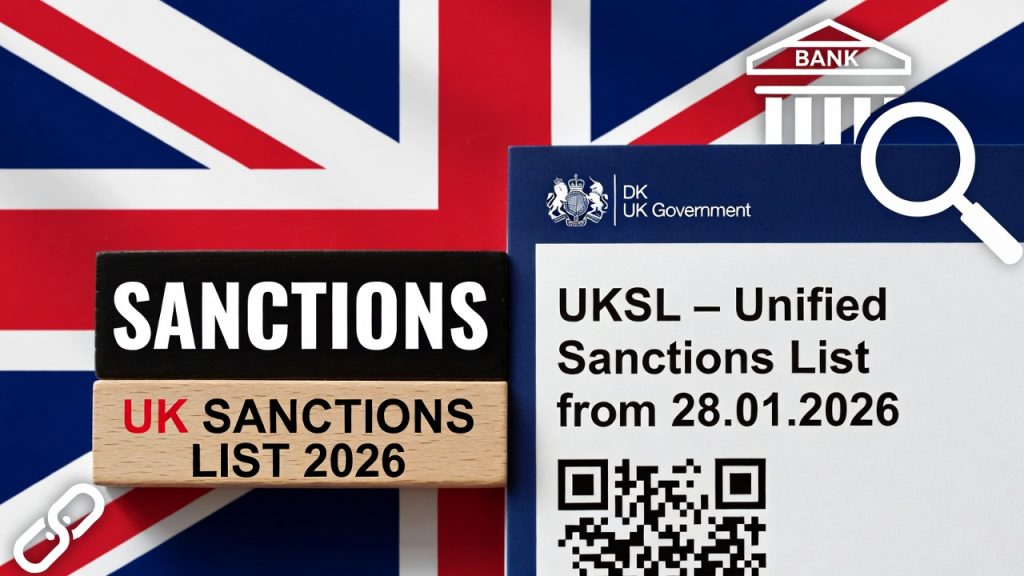
The dual-list system had two lists of persons sanctioned by the U.K. and also maintained by different entities.
Obliged entities operating in the EU and U.K., as well as those obligated entities performing U.K. exposed transactional activity should benefit from the elimination of the dual-list system.
An Obliged Entity can now screen against a single authoritative list rather than two, resulting in fewer false positive results when screening, less effort required for daily screening, and more clarity and transparency with respect to their audit trails.
What exactly changed?
- The OFSI Consolidated List and its search tool stopped being updated on 28 January 2026 and are now available only for historical reference.
- All new and existing designations (financial, immigration, trade, and transport sanctions under the Sanctions and Anti-Money Laundering Act 2018) are published exclusively on the UKSL.
- Newly designated persons receive only a Unique ID (the OFSI Group ID system has been retired for future designations, though historic Group IDs remain valid for legacy cases).
- The UKSL now offers seven download formats (the original four plus new TXT, CSV, and PDF) with static URLs — perfect for automated systems.
- The official search tool has been upgraded with fuzzy matching, ranked results, and better filtering for asset-freeze targets.
Full details and a helpful checklist are available in the official guidance.
Why this matters for EU/UK AML programmes
UK sanctions are still very relevant today for a lot of European obliged entities (such as banks, payment service providers, trade finance companies, cryptocurrency businesses and professional services) due to the fact that cross-border clients, correspondent banking relationships and supply chains will often necessitate the application of UK sanctions screening requirements. Therefore, there should be a single list that all obliged entities can refer to so they do not have to carry out multiple searches and thereby reduce the friction and complexity of complying with the UK sanctions regime; the UK sanctions regime should therefore be brought into line with best practice internationally.
The transition however, does present some operational risks in the short term. All screening solutions, watchlists, databases and in house tools which continue to access the old OFSI Consolidated List after 28 January 2026 are now out of date. The failure to include even one new designation could result in your firm being found by regulators to be in breach of their duties, resulting in fines or reputational loss.
Action point for every AML compliance officer
Check your software vendor today.
If your organisation uses third-party screening software, sanctions databases, or automated KYC/ongoing-monitoring platforms, it is essential to confirm that the provider has fully migrated to the UKSL as the primary (and only) data source. Key questions to ask your vendor immediately:
- Have you switched all new designations to the UKSL Unique ID and “Sanction Type” fields?
- Are you using the static URLs for the seven new formats?
- Has the OFSI Consolidated List feed been retired in your system?
- Are you pulling from the upgraded UK Sanctions List search tool where appropriate?
Most reputable providers announced updates in late 2025, but experience shows that not every system is 100 % ready on day one. A quick audit now can prevent months of manual workarounds later.
Recommended next steps
- Subscribe to the official UK sanctions email alerts.
- Update internal policies and procedures to reference the UKSL exclusively.
- Run a parallel test: screen a sample of high-risk clients against both the old OFSI list (for history) and the live UKSL to validate your results.
- Document the change for your next AML audit or regulatory visit — supervisors on both sides of the Channel appreciate proactive evidence of system updates.
Final thought
The move to a single UK sanctions list is a genuine step forward for efficiency and accuracy. For AML teams already stretched across multiple jurisdictions, it removes one layer of complexity at a time when regulatory expectations continue to rise. The only remaining task is to make sure your technology has caught up.
At aml4.eu we help obliged entities across the EU and UK implement and maintain robust, regulator-ready screening and monitoring solutions. If you would like us to review your current sanctions setup against the new UKSL requirements, contact our compliance team — we’ll be happy to assist.
Stay compliant. Stay ahead.